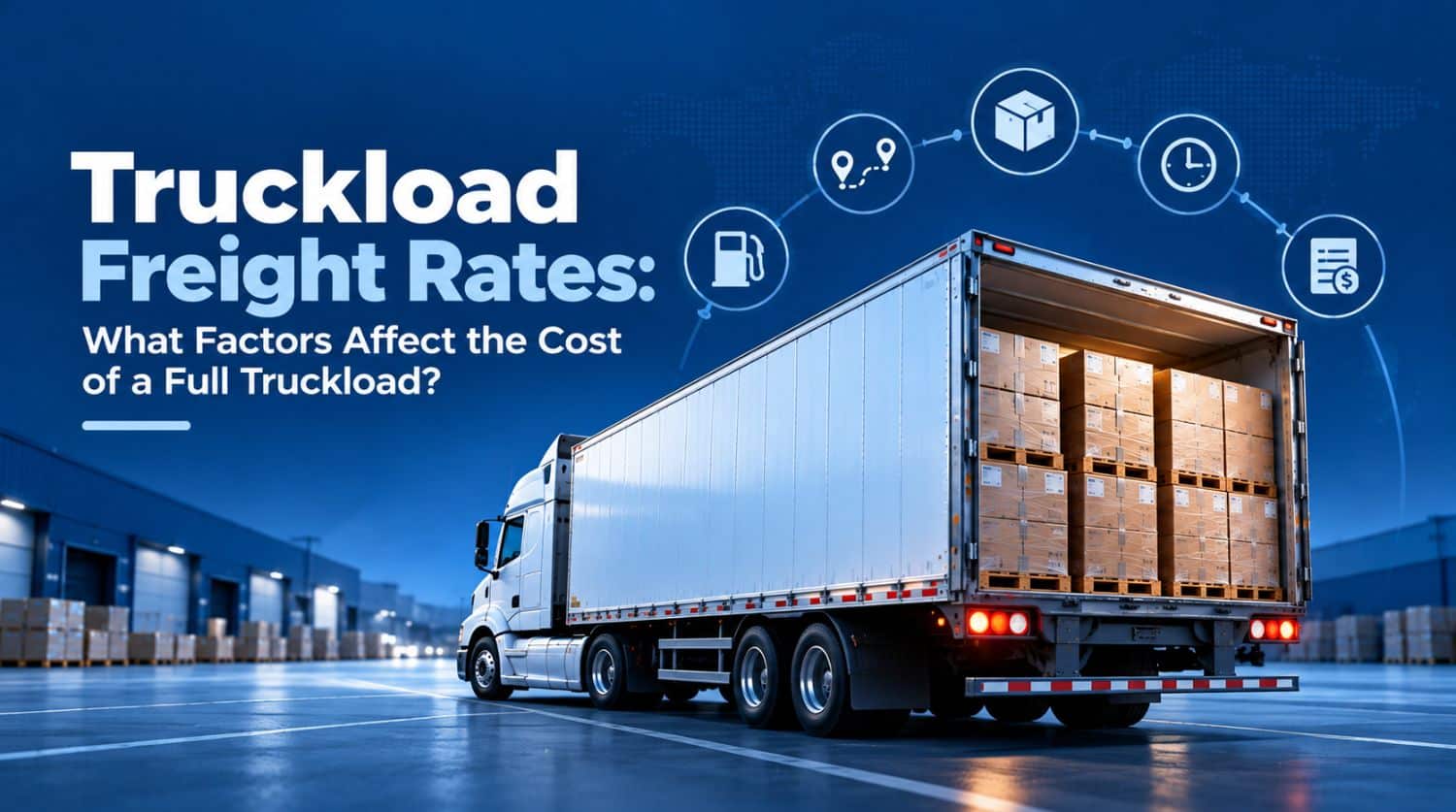
You get two quotes for the same lane, and they don’t match. That happens more than most shippers expect. Truckload freight rates aren’t one flat number. They’re built from several moving parts, and each one changes the price on its own.
This guide breaks down what actually drives full truckload shipping rates, in plain terms, so you can spot a fair quote when you see one.
- Distance and lane direction are the starting point for most truckload rates
- Equipment type (dry van, reefer, or flatbed) changes the base price
- Fuel surcharges move with diesel prices and get added on top of the linehaul rate
- Market capacity, meaning how many trucks are available versus how much freight needs to move, can push rates up or down fast
- Accessorial fees like detention or liftgate service are billed separately from the base rate
Distance and Lane
Most truckload rates start with distance. The farther the truck drives, the more you pay. But it’s not just about miles. The direction matters too.
Some lanes are “hot,” meaning lots of freight moves that direction, and carriers can easily find a return load. Other lanes are “cold,” meaning a truck might have to drive back empty. Carriers price cold lanes higher to cover that empty return trip. Freight pricing guides confirm that lane and direction, not just raw mileage, are the starting point for most truckload quotes.
Short hauls also cost more per mile than long ones. A 300-mile trip and a 1,500-mile trip both have fixed costs, like the driver’s time getting loaded and unloaded. Spread over fewer miles, that fixed cost pushes the short-haul rate higher on a per-mile basis.
Let Norfleet Transportation help coordinate your freight with solutions tailored to your shipment requirements, delivery timelines, and transportation needs.
Equipment Type
Not every truck is the same, and neither is the price.
Dry Van
A dry van is the standard enclosed trailer used for most general freight. It’s usually the cheapest equipment type, since it’s the most common and widely available.
Refrigerated (Reefer)
Reefer trailers keep temperature-sensitive freight cold or frozen. They cost more to run, since the trailer needs fuel to power the refrigeration unit on top of the truck itself. That extra cost shows up in the rate.
Flatbed
Flatbed trailers haul freight that doesn’t fit in an enclosed trailer, like steel, lumber, or oversized machinery. Flatbed rates usually run higher than dry van, partly because the freight needs tarps and strapping, and partly because fewer trucks are set up to haul it.
Fuel Surcharges
Fuel surcharges sit on top of the base rate, and they move with diesel prices. Carriers usually charge this per mile, based on how much diesel costs compared to a set baseline price written into the contract.
Here’s a simple way to picture it: if diesel costs more than the baseline, the surcharge goes up. If diesel drops, the surcharge shrinks. On a long haul, that difference can add hundreds of dollars to the total cost. Detailed fuel surcharge breakdowns show how carriers calculate this cents-per-mile add-on. That’s also why two carriers quoting the same linehaul rate can still land on very different total prices once fuel is added in.
Market Capacity
Freight rates rise and fall with supply and demand, just like any other market. When there are more loads than trucks, rates go up. When trucks outnumber the freight available, rates come down.
This is why the same lane can cost more in one month than another, even with no change in distance or equipment. Tight capacity during peak shipping seasons, bad weather, or a shortage of drivers in a region can all push rates higher for a while.
Some seasons are predictably tighter than others. Produce season in late spring and early summer pulls trucks toward agricultural regions, tightening capacity elsewhere. The weeks before major holidays often see the same effect, as retailers rush freight to meet demand. Shippers who know these patterns can plan around them, booking earlier or locking in contract rates before the tightest stretches hit.
Accessorial Charges
Accessorials are extra fees for anything beyond a simple pickup and delivery. Common ones include:
- Detention pay, charged when a driver waits too long to load or unload
- Liftgate service, for locations without a loading dock
- Layover fees, if a driver has to wait overnight
- Extra stops, if the load needs to be picked up or dropped off at more than one location
None of these show up in a basic linehaul quote. Ask about them before you book, so the invoice matches what you expected.
Weight and Freight Density
Weight matters for truckload pricing, but mostly at the extremes. Most FTL freight fills the trailer’s space before it hits the legal weight limit. So weight alone doesn’t move the price much in the middle range. Very heavy or dense freight is different. It can push the rate higher, since it limits what else the truck can carry or how the load needs to be secured.
How to Get a Better Truckload Rate
A few habits make a real difference here. Book early when you can, since last-minute loads often cost more. Stay flexible on pickup dates if your freight allows it. And build a relationship with a carrier who knows your freight. A shipper with steady, predictable volume usually gets better pricing than one booking one-off loads through a different broker every time.
Working with a dedicated full truckload shipping provider who understands your lanes can also smooth out a lot of this. A carrier that already knows your freight, your pickup locations, and your typical volume can quote faster and more accurately than one starting from scratch each time.
Let Norfleet Transportation help coordinate your freight with solutions tailored to your shipment requirements, delivery timelines, and transportation needs.
Contract Rates vs. Spot Rates
There are two ways to book truckload freight, and the price can look very different depending on which one you use.
Contract Rates
A contract rate is a price you agree on with a carrier ahead of time, usually for a set period like six months or a year. It stays steady even when the spot market moves. This works well for shippers with predictable, repeat volume.
Spot Rates
A spot rate is priced for a single load, based on current market conditions at the moment you book. Spot rates can run higher than contract rates when capacity is tight, sometimes by a wide margin. They can also run lower when trucks are plentiful, and freight is light.
Shippers who move freight often save money by locking in contract rates on their core lanes, then using the spot market only to fill gaps.
A Real-World Example
A regional building supply company kept getting rate quotes that swung wildly from one week to the next, even on the same lane. After digging into it, the pattern was clear. Their loads were going out on a Friday, into a lane that carriers considered “cold” heading into the weekend. Simply shifting pickups to a Tuesday or Wednesday changed things. Carriers had an easier time finding a return load, and their average rate dropped, with no change to the freight, the distance, or the carrier.
Final Thought
Truckload freight rates look confusing from the outside, but they come down to a handful of clear factors: distance, equipment, fuel, market conditions, and extra fees. Once you know what’s driving the number, a rate quote stops feeling random and starts making sense.
FAQs
What is the biggest factor in truckload freight rates?
Distance and lane direction usually matter most. Carriers price based on how far a truck travels and whether it’s likely to find a return load headed back.
Why do truckload rates change so much week to week?
Market capacity shifts often. Seasonal freight surges, weather, or a shortage of trucks in a region can push rates up or down, even on the same lane.
Are flatbed rates always higher than dry van rates?
Usually, yes. Flatbed freight often needs tarps, strapping, and specialized handling, and fewer trucks are equipped for it, which pushes the rate above a comparable dry van load.
Do fuel surcharges apply to every truckload shipment?
Yes. Nearly all truckload carriers apply a fuel surcharge on top of the base rate, and it adjusts as diesel prices move.
Can I lower my truckload shipping costs without changing carriers?
Yes. Booking earlier, staying flexible on pickup dates, and avoiding “cold” lane days can lower your rate even with the same carrier and the same freight.
Should I use contract rates or spot rates for my freight?
It depends on your volume. Contract rates work best for steady, repeat freight, since they lock in a stable price. Spot rates make more sense for occasional or one-off shipments.