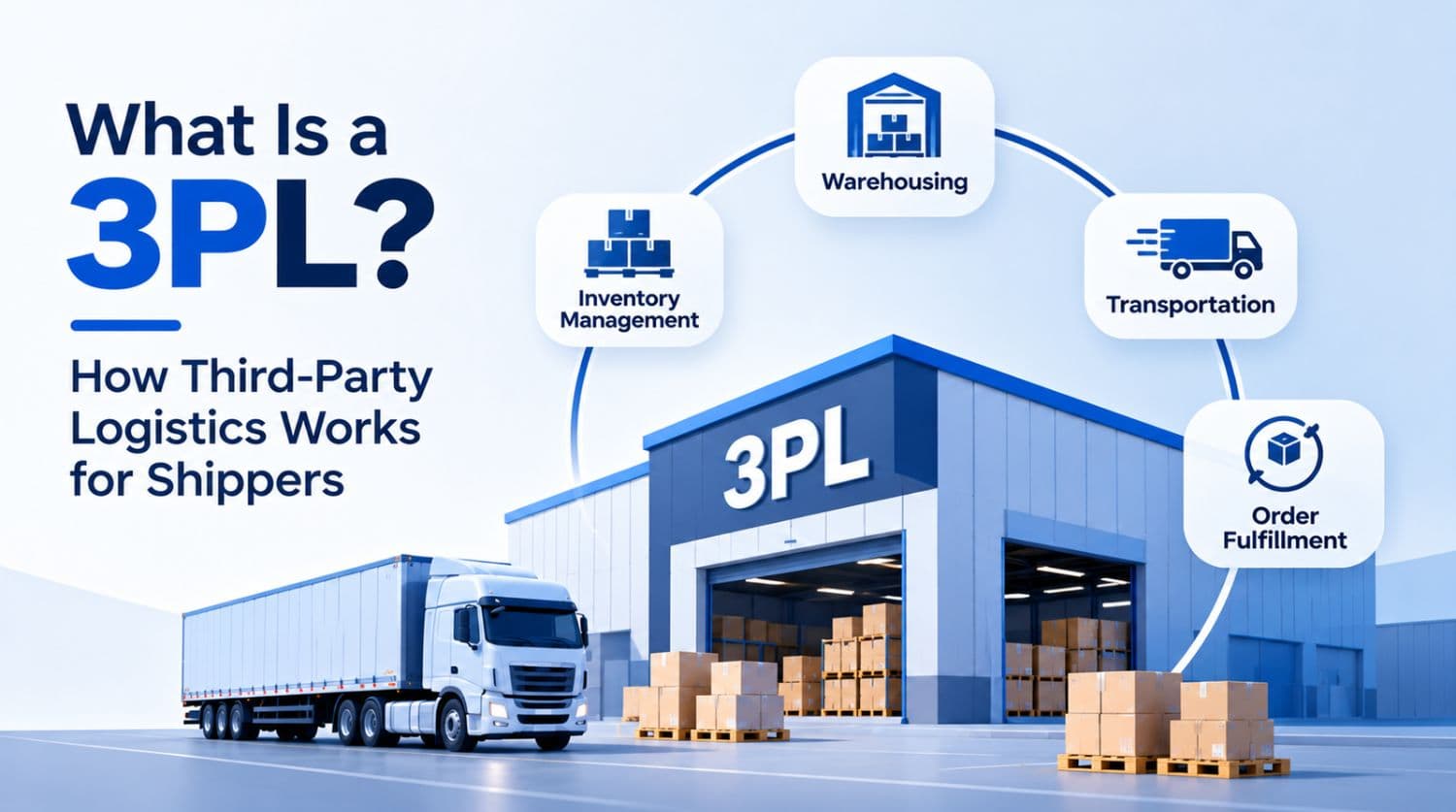
Running your own warehouse. Managing your own trucks. Handling every return by hand. That’s a lot for any growing business to take on. Most companies don’t do it alone. They use a 3PL instead. So what is 3PL, exactly, and how does it actually work for shippers like you?
This guide explains what a 3PL actually is, what it does, and when it makes sense for your business.
- 3PL stands for third-party logistics, a company that handles logistics work for you
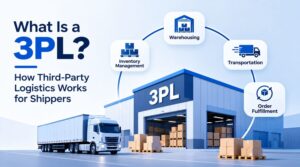
- Common services include warehousing, fulfillment, transportation, and returns
- Some 3PLs own their own trucks and warehouses. Others don’t
- A 3PL is different from a freight broker, though the two roles can overlap
- Most businesses turn to a 3PL when in-house logistics starts costing more than it saves
What Does 3PL Mean?
3PL stands for third-party logistics. It’s a company that manages some or all of your supply chain work. That can include storing your inventory, packing and shipping orders, arranging freight, and handling returns.
Instead of building your own warehouse and hiring your own logistics team, you hand that work to a 3PL. They already have the space, the staff, and the systems in place. You pay for the service instead of building the infrastructure yourself.
What Services Do 3PL Providers Offer?
Not every 3PL does the same thing. Most offer a mix of these core services.
Warehousing and Fulfillment
This is often the biggest piece. A 3PL stores your inventory, then picks, packs, and ships orders as they come in. Some also handle kitting, labeling, and quality checks before an order goes out.
Transportation and Freight
Many 3PLs also arrange transportation. That can mean booking truckload or LTL freight, planning routes, or coordinating last-mile delivery to the final customer.
Inventory and Technology
A good 3PL gives you visibility into your own inventory. Most provide a dashboard or software system. You can see stock levels, track shipments, and manage orders without picking up the phone every time.
This kind of visibility matters more than it might seem. Without it, you’re often just trusting that things are fine, with no real way to check. A good dashboard turns that guesswork into something you can actually see.
Let Norfleet Transportation help coordinate your freight with solutions tailored to your shipment requirements, delivery timelines, and transportation needs.
Types of 3PL Providers
Not all 3PLs are built the same way. The biggest difference comes down to whether they own their equipment.
Asset-Based 3PLs
Asset-based providers own their own trucks, warehouses, or both. They run the operation directly, without relying on outside vendors. This often means more control and more consistency for you as the shipper. If something goes wrong, there’s one company to call, not a chain of subcontractors.
Non-Asset-Based 3PLs
Non-asset-based providers don’t own trucks or warehouses. Instead, they coordinate a network of outside partners to get the work done. This can mean more flexibility, since they’re not limited to their own equipment. They can often scale up quickly or reach new regions without building new facilities first.
Hybrid 3PLs
Some providers fall in between. They own certain assets, like a regional warehouse network, while relying on outside carriers for transportation. This hybrid approach can offer a balance of control and flexibility, depending on what a shipper actually needs.
How Is a 3PL Different From a Freight Broker?
This one trips people up. A freight broker only arranges transportation. A 3PL usually does a lot more than that. That can include warehousing, fulfillment, and inventory management on top of freight. Industry breakdowns of the logistics space put it simply. Every freight broker is a type of 3PL, but not every 3PL is a freight broker. If all you need is help booking freight, a broker may be enough. If you need help with storage and fulfillment too, you’re looking for a full 3PL.
Benefits of Using a 3PL
Handing off logistics work comes with real advantages. A 3PL usually gives you:
- Lower costs than building your own warehouse and fleet
- Access to established carrier relationships and better freight rates
- More time to focus on your core business instead of logistics
- Room to grow without adding warehouse space yourself
Broader industry research on outsourced logistics points to steady, sustained growth in the 3PL market over the past several years, a sign that more businesses are making this same choice.
Beyond the numbers, there’s a simpler reason so many businesses make this switch. Logistics is a specialized skill. Running it well takes dedicated systems and people. Most companies would rather put that time and money into the product or service they actually sell.
When Does It Make Sense to Use a 3PL?
Signs it might be time to bring on a 3PL:
- Your order volume has outgrown your current space or team
- You’re spending more time managing logistics than running your business
- Shipping errors or delays are becoming more common
- You want to expand into new regions without opening a new warehouse
- Your freight costs feel high, and you’re not sure why
If two or three of these sound familiar, it’s worth at least getting a quote from a 3PL to compare.
Quick example: A small furniture company outgrew its own storage space within a year. Orders were being packed in a cramped back room, and late shipments were becoming routine. Moving fulfillment to a 3PL freed up that space, cut shipping errors, and let the team focus on sourcing new products instead of packing boxes.
What Does It Cost to Work With a 3PL?
Pricing varies a lot depending on what services you need. Warehousing is usually priced by space used or by unit stored. Fulfillment is often priced per order, covering pick, pack, and shipping. Freight is priced separately, based on the shipment itself.
Ask any 3PL for a breakdown of these costs before signing on. A clear, itemized quote is much easier to compare than one flat number that hides what you’re actually paying for.
How to Get Started With a 3PL
Getting started is usually simpler than people expect. Most providers walk you through a short onboarding process:
- Share your current order volume and growth plans
- Ask what services you actually need, not just what’s offered
- Get a clear, itemized quote before signing anything
- Start with a trial period or a smaller portion of your volume if that’s an option
- Check in regularly once you’re live to make sure service matches what was promised
Starting small, even with just one product line or region, is a common way to test a new 3PL relationship before committing fully.
Let Norfleet Transportation help coordinate your freight with solutions tailored to your shipment requirements, delivery timelines, and transportation needs.
Final Thought
A 3PL isn’t just an outside vendor. Done well, it becomes an extension of your own operation. The right partner takes on the parts of logistics that slow your business down, from warehousing to freight to fulfillment. Working with dedicated logistics services can free up real time and resources you can put back into growing your business, not just moving boxes.
FAQs
What does 3PL stand for?
3PL stands for third-party logistics, a company that manages supply chain tasks like warehousing, fulfillment, and transportation on behalf of another business.
Is a 3PL the same thing as a freight broker?
No, a freight broker only arranges transportation, while a 3PL usually handles a wider range of services, including warehousing and fulfillment, and freight brokers are actually one type of 3PL.
How do I know if my business needs a 3PL?
You likely need a 3PL if your order volume has outgrown your space, shipping errors are increasing, or logistics is taking up more time than it should.
Do all 3PLs own their own warehouses and trucks?
No, some 3PLs, called asset-based providers, own their equipment directly, while others coordinate a network of outside carriers and facilities instead.
Does using a 3PL save money?
For most growing businesses, yes. A 3PL often costs less than building your own warehouse and fleet, and it can also unlock better freight rates through established carrier relationships.
What’s the difference between an asset-based and non-asset-based 3PL?
An asset-based 3PL owns its own trucks and warehouses, while a non-asset-based 3PL coordinates a network of outside partners instead of owning the equipment itself.