Every shipper eventually hits the same fork in the road: book a full truck, or share trailer space and pay only for what you use. Get the call wrong in either direction, and it shows up fast, either as an invoice for space you didn’t need, or as reclassification fees and delays from squeezing too much freight into a shared trailer.
The choice between full truckload (FTL) and less than truckload (LTL) shipping isn’t about which mode is better. It’s about matching the mode to the load, the deadline, and the freight itself. This guide breaks down how FTL vs LTL shipping actually differ in cost, speed, and handling, and how to decide which one fits your next shipment.
What Is Full Truckload (FTL) Shipping?
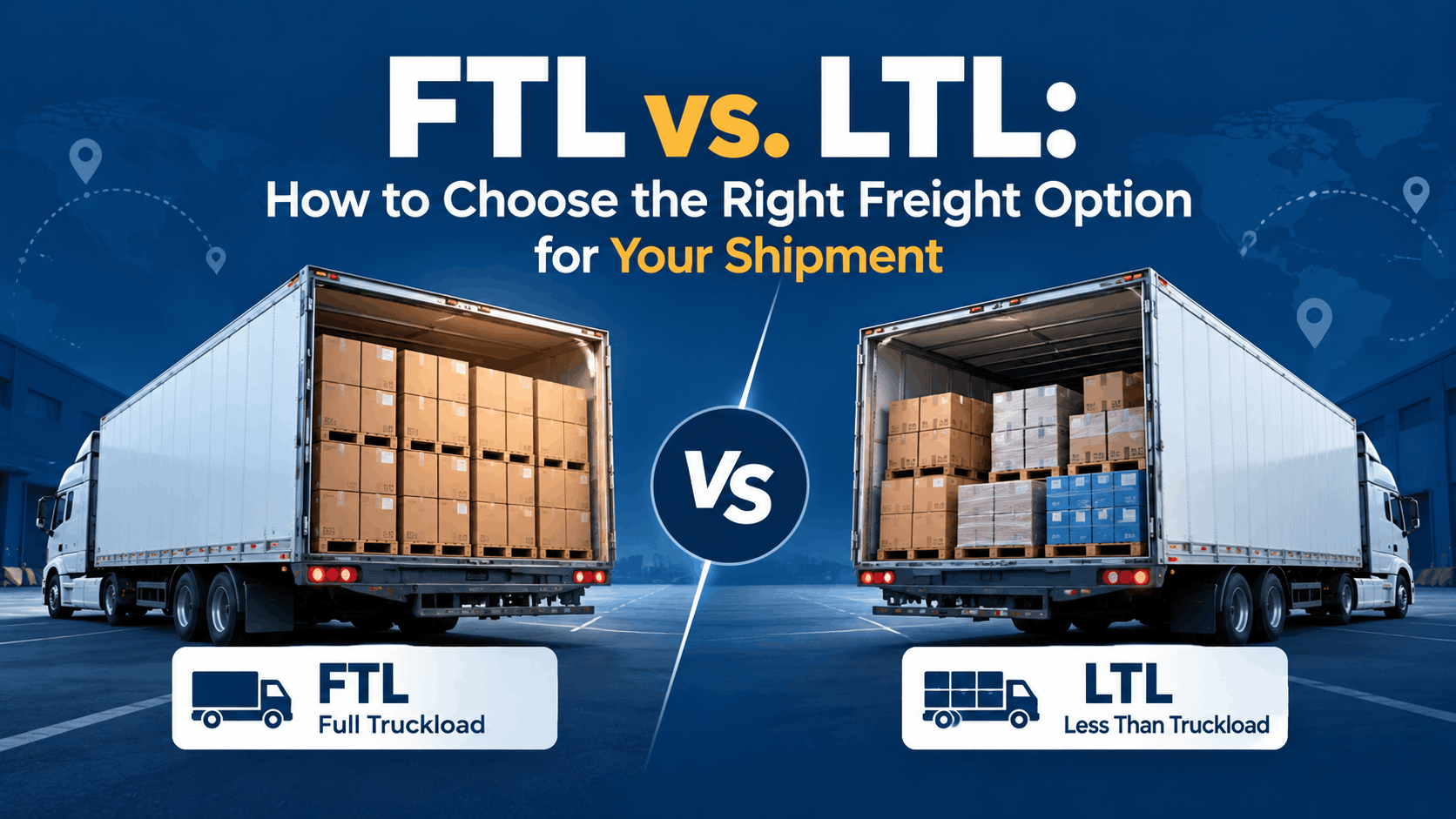
Full truckload shipping reserves an entire trailer for one shipper’s freight. The truck loads at origin and drives directly to the destination, with no stops at carrier terminals and no other shipments sharing space along the way. Because nothing is loaded or unloaded in transit, FTL typically offers the fastest, most predictable transit time of any surface freight option, along with the lowest risk of damage from repeated handling.
Freight class is largely irrelevant in FTL pricing, since you’re paying for the whole trailer regardless of how it’s packed. That makes FTL a strong fit for businesses moving large volumes, time-sensitive freight, or goods that shouldn’t be touched more than twice: once at pickup, once at delivery.
What Is Less Than Truckload (LTL) Shipping?
Less than truckload shipping lets multiple shippers share space in the same trailer, each paying only for the portion of the truck their freight occupies. Rather than moving directly from origin to destination, LTL freight usually travels through a hub-and-spoke network: picked up locally, consolidated at a terminal, transferred to a linehaul truck, then broken down again at a destination terminal before final delivery.
That network is what makes LTL the more affordable option for smaller shipments, and it’s also the reason LTL takes longer and involves more handling touchpoints than FTL. Every terminal stop is a chance for freight to sit, get reshuffled, or get bumped from a load plan.
FTL vs LTL: Key Differences at a Glance
| Factor | FTL | LTL |
| Typical shipment size | 15,000+ lbs, full trailer | 150 to 15,000 lbs, roughly 1 to 6 pallets |
| Handling | Loaded once, unloaded once | Multiple terminal handoffs |
| Transit time | Direct, fastest available | 1 to 5 days longer on average |
| Pricing basis | Per mile, flat trailer rate | Per hundredweight and freight class |
| Damage risk | Lower | Higher, due to repeated handling |
Cost Comparison: FTL vs LTL Rates in 2026
Full truckload vs less than truckload pricing runs on two completely different models, which is exactly why cost comparisons trip shippers up. FTL rates are priced per mile for the whole trailer, generally landing between $2.30 and $3.50 per mile for dry van freight depending on lane, fuel, and season. LTL rates are priced per hundredweight and freight classification instead, typically running $0.20 to $0.45 per pound, with a single pallet averaging $120 to $250.
The break-even point between the two modes generally falls around 8 to 12 pallets, or 10,000 to 15,000 pounds. Below that range, LTL is almost always cheaper. Above it, the flat per-mile FTL rate usually wins on total cost, even if the trailer isn’t full. That math has been shifting too: LTL contract rates have climbed to roughly $46.40 per hundredweight, up about 14% year over year in 2026, according to independent freight cost benchmarking data. As LTL pricing climbs, that break-even point tends to creep lower, meaning more mid-size shipments are becoming cheaper to move as FTL than they were a year ago.
Transit Time and Handling
Speed and handling are where the two modes diverge most sharply. FTL freight moves directly from pickup to delivery with zero intermediate stops, so transit time is essentially a function of distance and hours-of-service limits. LTL freight, by contrast, typically adds one to five extra days versus a comparable FTL move, purely because of hub-and-spoke routing and multiple handling points along the way.
Capacity conditions in 2026 are adding another layer to this decision. The American Trucking Associations’ For-Hire Truck Tonnage Index rose a total of 4.7% since the end of 2025, according to recent trucking industry data, a sign that demand for truck capacity, and the pricing pressure that comes with it, isn’t easing. When capacity tightens, FTL reliability becomes worth more, since a dedicated truck doesn’t sit in a terminal network waiting on space the way LTL freight can.
When to Choose FTL
FTL is the stronger choice when a shipment clears roughly 10,000 to 15,000 pounds, when a delivery deadline leaves no room for hub delays, or when the freight is fragile, high-value, or otherwise shouldn’t be handled more than twice. It also makes sense any time reliability matters more than shaving a few dollars off the rate, since a dedicated truck removes the terminal network entirely from the equation.
For shipments that fit this profile, working with a dedicated full truckload freight provider means the load moves on your timeline, not a terminal’s.
When to Choose LTL
LTL makes the most sense for shipments between roughly 150 and 15,000 pounds, or about one to six pallets, especially when shipments go out frequently in smaller quantities rather than one large load at a time. It’s also the better fit when a business needs accessorial services like liftgate or inside delivery, or when several small orders headed the same direction can be consolidated to spread the cost further.
The trade-off is that getting freight classification right matters more than it used to. A misclassified pallet or an unflagged liftgate stop can erase the savings LTL is supposed to deliver. Working with an experienced LTL freight partner who classifies the first time correctly keeps those savings intact.
A Real-World Example
Consider a mid-size home goods distributor shipping ceramic tableware to retail partners. Early on, the company defaulted to LTL for every order under 20 pallets, assuming smaller always meant cheaper. On loads in the 9- to 11-pallet range, that assumption was quietly costing them money: LTL’s per-pound pricing on that volume, plus the damage claims from multiple terminal handoffs on fragile inventory, added up to more than a dedicated truck would have cost outright.
After switching those mid-size, fragile loads to FTL and reserving LTL for genuinely small shipments under six pallets, the company cut both freight spend and damage claims within a single quarter. The lesson wasn’t that one mode is superior. It’s that the wrong mode on the wrong load compounds quietly until someone actually runs the comparison.
Making the Right Call for Your Shipment
Before booking, weigh four factors together rather than defaulting to habit: shipment weight and pallet count, how time-sensitive the delivery is, how fragile or high-value the freight is, and how tight current capacity is on your specific lane. A shipment that falls in the gray zone, roughly 8 to 12 pallets, deserves a real quote comparison rather than a guess, since that’s exactly where the cost lines cross.
Final Thought
FTL and LTL aren’t competing options so much as two tools built for different jobs. The businesses that control freight costs most effectively aren’t the ones that pick a mode and stick with it out of habit. They’re the ones that reevaluate mode by shipment, especially as pallet counts, deadlines, or market capacity shift from one order to the next.
FAQs
What is the main difference between FTL and LTL shipping?
FTL reserves an entire trailer for one shipment and moves it directly from pickup to delivery, while LTL shares trailer space among multiple shippers and routes freight through terminal hubs, which adds cost savings for smaller loads but also adds transit time.
At what shipment size does FTL become cheaper than LTL?
FTL typically becomes the more cost-effective option once a shipment reaches around 10,000 to 15,000 pounds or 8 to 12 pallets, since LTL’s per-pound pricing scales upward while the FTL flat rate stays fixed.
Is LTL shipping slower than FTL?
Yes. LTL shipments generally take one to five days longer than a comparable FTL move because freight passes through multiple terminal stops instead of traveling directly to its destination.
Can I combine several small shipments to save on LTL costs?
Yes. Consolidating multiple smaller orders headed to the same region into a single LTL shipment is one of the most effective ways to reduce per-pound freight costs without upgrading to a full truckload.
Which option is better for fragile or high-value freight?
FTL is generally the safer choice for fragile or high-value goods, since it eliminates the repeated loading and unloading that happens at LTL terminals, reducing the risk of damage in transit.